1/5HP 3.5 CFM Vacuum Pump Kit: HVAC Manifold Gauges
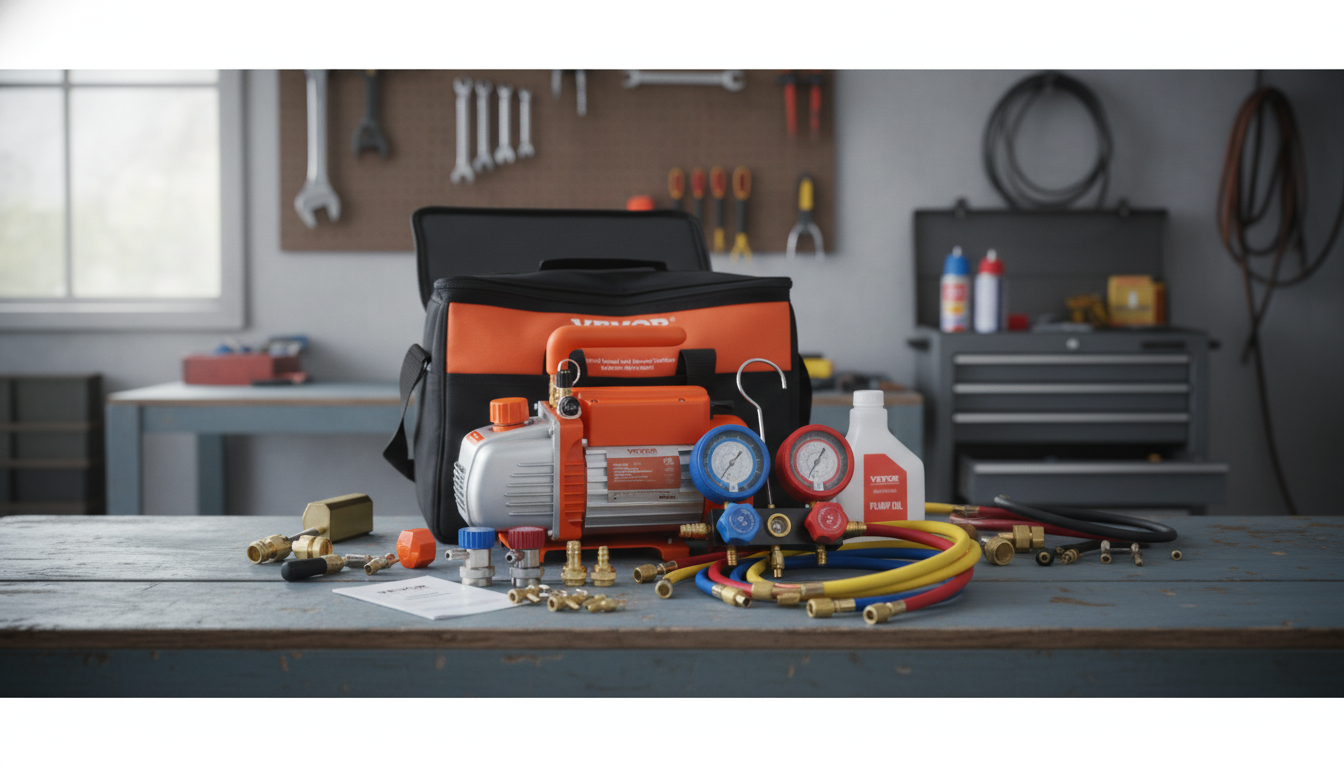
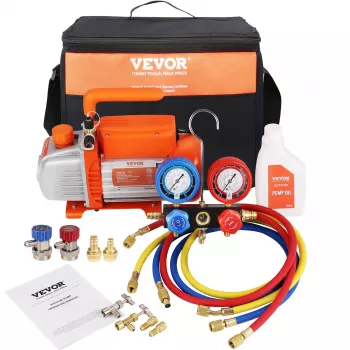
1/5HP 3.5CFM Vacuum Pump and Manifold Gauge Set for HVAC Refrigerant Work
A compact vacuum pump paired with a manifold gauge set helps evacuate air and moisture, verify system pressures, and support reliable charging and service work on common HVAC and refrigeration equipment. This guide explains what the kit does, which specifications matter most, how to set it up for a clean evacuation, and practical ways to avoid the issues that commonly waste time on service calls.
What This Kit Is Used For
- Evacuating HVAC and refrigeration systems before charging to reduce moisture-related problems, protect components, and help the refrigerant operate as intended.
- Measuring low-side and high-side pressures during diagnostics, evacuation preparation, and charging steps.
- Common applications: residential split systems, mini-splits, heat pumps, and general refrigeration maintenance. (Automotive-style setups may be possible when the correct hoses/fittings are used.)
- Best practice reminder: evacuation quality is confirmed with a micron gauge (not included in most gauge sets).
For legal and safety requirements around refrigerant handling, review U.S. EPA Section 608 guidance and local rules. For broader technical references, ASHRAE resources can be helpful.
What’s Included and How the Parts Work Together
This style of kit combines two jobs: creating the vacuum needed for dehydration and removal of non-condensables, and monitoring pressures during service. Each piece matters because a small leak or restriction anywhere in the chain can prevent a deep, stable evacuation.
- Vacuum pump: pulls the system down into a deep vacuum so moisture can boil off and be removed.
- Manifold gauge set: two gauges plus valves that control flow to the service hoses; used to monitor pressures and control evacuation/charging.
- Service hoses and connectors: link the manifold to the system and to the pump; correct connection order reduces contamination and leaks.
- Valves and caps: help isolate the system for standing vacuum tests to spot vacuum rise from leaks or leftover moisture.
| Component | Role | Common User Check Before Starting |
|---|---|---|
| Vacuum pump | Creates vacuum to remove air/moisture | Correct oil level; clean oil; power cord condition |
| Manifold gauges | Reads pressures and controls flow | Gauges at zero; valves turn smoothly; no visible cracks |
| Hoses | Connects system/manifold/pump | No kinks; seals intact; fittings thread cleanly |
| Fittings/adapters | Matches service ports and hose ends | Correct size; O-rings present; snug fit without overtightening |
Key Specs That Matter (and What They Mean in Practice)
Two numbers stand out on this kit: 1/5HP and 3.5 CFM. They don’t automatically guarantee a perfect evacuation—leaks and moisture dominate results—but they do set expectations for speed and workload.
- Motor power (1/5HP): influences how the pump handles continuous operation and how it performs under load. For many light-to-medium service tasks, this is a practical, portable power class.
- Flow rate (3.5 CFM): affects pull-down speed. Larger system volume, longer line sets, and moisture-heavy systems generally take longer and benefit from higher CFM and better flow practices (like removing Schrader cores).
- Vacuum depth capability: deeper vacuum supports better dehydration, but confirmation requires a micron gauge because manifold gauges aren’t designed for deep vacuum measurement.
- Gauge readability: clear markings and stable needles help reduce misreads during diagnostics and charging.
- Hose sealing: tiny leaks at hose gaskets, loose fittings, or Schrader cores can cause “won’t pull down” symptoms and false leak suspicions.
At-a-Glance Specs for This Kit
| Spec | Value | Why It Matters |
|---|---|---|
| Motor power | 1/5 HP | Supports continuous pull-down for many typical service calls |
| Pump displacement | 3.5 CFM | Faster evacuation on moderate system volumes than lower-CFM options |
| Kit type | Vacuum pump + manifold gauge set | Covers evacuation and pressure monitoring with one package |
| Typical use | HVAC/refrigeration service | Intended for evacuation, diagnostics, and charging workflows |
Setup and Evacuation Workflow (Practical, Step-by-Step)
A consistent setup routine reduces contamination, prevents hose leaks, and makes standing vacuum tests more meaningful.
Charging and Diagnostics Tips Using a Manifold Gauge Set
- Use the correct refrigerant: follow the equipment nameplate and required procedures. Mixing or substituting refrigerants can damage equipment and violate regulations.
- Read pressures in context: pressure changes with outdoor temperature, indoor load, airflow, and metering device type. Use stable conditions when possible.
- Charge the correct way: avoid shortcuts when liquid charging is required by the procedure; improper charging methods can risk compressor damage.
- Purge hoses to minimize non-condensables: purge air from hoses before opening to the system to keep air out of the circuit and reduce erratic pressure behavior.
- Pair pressure with temperature: superheat/subcooling depends on accurate line temperature measurements, not gauge readings alone. For refrigerant property references, NIST REFPROP is a respected starting point.
Maintenance, Storage, and Safety
Common Problems and Fast Fixes
Who This Kit Fits Best
In-Stock Picks
- 1/5HP 3.5CFM Vacuum Pump and Manifold Gauge Set – HVAC Refrigerant Kit
- Toddler Baby Goose Embroidered Knit Sweater – Cozy Fall & Winter Pullover
FAQ
Is 3.5 CFM enough for evacuating a typical residential HVAC system?
Often yes for many residential and light commercial systems, but evacuation time varies with system volume, line length, moisture level, and restrictions. Confirm results with a micron gauge rather than relying on a fixed time estimate.
Do manifold gauges show microns for evacuation?
No. Manifold gauges read pressure (PSI/bar) and are not accurate for deep vacuum measurement. Use a dedicated micron gauge to confirm dehydration and leak-tightness.
How often should vacuum pump oil be changed?
Change it when it looks cloudy or contaminated, after moisture-heavy evacuations, or when the pump struggles to achieve or hold a deep vacuum. Clean oil improves vacuum performance and helps extend pump life.















Leave a comment